


A Global Programme. Now in Singapore.
Since 2013, the Arizona Trauma Institute has been a leader in trauma-informed education. The Trauma and Resilience Life Coach certification brings that same internationally developed programme to Singapore, supported by Arizona Trauma Institute's international faculty.
🏅
Internationally Recognised Certification
The Trauma & Resilience Life Coach (TRLC) certification is recognised by the Center for Credentialing & Education (CCE) in the United States for continuing education.
Real stories.
Real Impact. 💛

‘‘
For me, having a trauma history and being a coach, there was a kind of gap between how do I get the tools and the practises and strategies that help me personally and how I do that in a coaching kind of way, and so there's this kind of chasm and gap that I had. And when I joined ATI, I knew that the mission deeply resonated with me, and I would have no idea that the gap would close by the end of my time with ATI.
Andy
TRLC PARTICIPANT
‘‘
I started to apply some of these tools immediately because I work with clients every single day, and I'm telling you, the level of transformation just exploded - it was incredible.
I'd learned a new principle, I'd start applying it, and all of a sudden, oh my god, wow! Like, people just felt so empowered. Two principles in particular: one is an asset-based approach where you kind of identify existing competencies in people.
Total Game Changer.
Jordan
TRLC PARTICIPANT
‘‘
In the last year, I have been able to really feel extremely confident in interacting with both patients and clients.
It allows me to understand better the reactions that I'm seeing, as well as the nonverbal behaviors, and also when I'm psycho educating or presenting helpful information to coaching clients, it really seems to click for people.
Adrienne
TRLC PARTICIPANT

THE REALITY IN SINGAPORE
Trauma doesn't announce itself.
But it shapes everything.
In Singapore's high-performance culture, emotional distress is often masked by achievement. Yet the effects are everywhere.
🧠
Burnout mistaken for laziness
Nervous systems running on overdrive are dismissed as personal failure — in workplaces, families, and schools.
🌿
Healing that doesn't last
Talking about problems often isn't enough. Without understanding the nervous system, change stays surface-level.
👨👩👧
Intergenerational wounds
The experiences our parents carried - war, poverty, migration, separation may still be living in our bodies. Understanding this changes everything.
🤝
Helpers without a framework
Coaches, educators, managers, HR professionals, faith and community leaders are on the frontline of distress with no training in trauma-informed care.
🔒
Stigma around mental health
Many people will never see a therapist — but they'll open up to a trusted coach, colleague, or friend who knows how to listen.
📈
Rising demand, scarce capacity
Mental health services are stretched. Trauma-informed practitioners — across all roles — have never been more needed.
WHO SHOULD ATTEND
This programme was built for two kinds of people.
The curriculum serves both — with different entry points and different transformations waiting at the end.
Deepen what you already know.
You may have clients who understand their story, know where their patterns come from, and genuinely want to change.
Yet they still feel stuck.
This gives you another way to understand what happens when clients stay stuck.
Why this matters in your work:

Recognise when insight isn't translating into change. Understand why someone can know exactly what happened to them and still struggle to move forward.
Know when trauma is beneath the behaviour. Recognise freeze, fawn, shutdown and dysregulation without automatically interpreting them as resistance or lack of motivation.
Ask questions that uncover capacity, helping clients recognise resources, agency & possibilities.
Expand how you support clients with coaching & resilience frameworks to your existing toolkit.
Bring neuroscience into the room so clients understand trauma responses as normal biology, without self-judgment.
Strengthen your own capacity to stay regulated so that you model for & co-regulate with your clients.
For coaches, educators, managers, HR, faith and community leaders
What if the behaviour isn't the whole story?
You observe behaviours like someone shuts down, or keeps avoiding the conversation seems unmotivated, overwhelmed or unable to move forward.
This programme helps you respond to trauma affected clients with confidence and care.
Why this matters in your work:
Look beyond "difficult" behaviour when someone shuts down, escalates, or can't seem to move forward.
Know what to ask or say without activating a trauma response.
Learn to ask better questions that help people discover their resourcefulness, assets and capacity to adapt to the situation.
Heal as you learn together with peers as you discover more insights and capacity to be resourceful.
Build resilience, not dependence by shifting conversations towards what is possible and what can help someone move forward.
Know when to hold space and co-regulate with your client without overstepping your boundary.
CURRICULUM OVERVIEW
25 weeks from foundations to embodied trauma-informed work.
4-hour-a-week commitment.
Six stages of learning, practice and integration — building the skills to recognise, respond and support meaningful change.
MODULE 1
Foundations
Nervous system literacy, safety & stabilisation, scope of practice and ethics.
Module 04
Trauma-Wise Psychoeducation
Explaining stress responses, reducing shame, building self-efficacy and supporting caregivers.
MODULE 02
Regulation Toolkit
Asset-based questioning, orientation, scale-based sensitising, pacing & titration.
Module 05
Applied Practice
Case walk-throughs, role play, feedback loops and adapting for diverse settings.
Module 03
Coaching Conversations
Dignity-protecting goals, collaborative planning, strengths discovery and motivational strategies.
Module 06
Integration
Boundaries, referrals, documentation, resilience & vicarious trauma protection, demonstration of learning, growth plan & practical next steps.

WHAT'S INCLUDED
Everything you need to go deep.
WHY THIS MATTERS HERE
Singapore is ready for this conversation.
1 in 7
Singaporeans experiences a mental health condition in their lifetime.
Awareness of mental health is growing, but trauma-informed practitioners remain rare. That gap is an opportunity — and a responsibility — for those willing to step into it.
Whether you work in a clinic, a school, a corporate setting, or run your own practice, the ability to recognise and respond to trauma is becoming foundational — not specialist. This is the moment to build that capacity.
75%
Of adults with mental health issues never seek professional help — but many will talk to a trusted person in their life.
6 months
Is all it takes to gain a credential that most professionals in Singapore don't have.
SUPPORTED BY THE INTERNATIONAL TRAINERS
Expertise spanning the globe.
The Singapore Cohort is supported by experienced educators from the Arizona Trauma Institute, bringing decades of combined experience in trauma, resilience, coaching and nervous system-informed practice.
These faculty members contribute to the international curriculum and support the quality and consistency of the programme delivered in Singapore.

Robert Rhoton
PsyD, LPC, F.A.A.E.T.S.
-
Trauma Physiology
-
The Salutogenic Method
-
Asset-Focused Coaching

Kayli Gibbs
MS, TRLC, RYT, CSCS
-
Scientifically Proven Somatic & Body-Based Self-Regulation

Roderick Logan
DPTh, CCTS, CFTP, FFTT
-
Physiology of Stress & Resiliency
-
Burnout & Fatigue Prevention

Candice Liozu
PC, ACC, TRLC
Executive Coach
Trauma & Resilience Coach / Trainer
-
Coaching Tools & Resources
-
Creating a Coaching Business
YOUR SINGAPORE FACILITATORS
Clinically grounded.
Locally rooted.
Led by three practitioners who don't just teach this work — they live it.

Psychotherapist & Clinical Hypnotherapist,
Advanced Clinical Trauma Specialist
Bernadette Chin is a psychotherapist and clinical hypnotherapist, and founder of My Inner Child Clinic in Singapore. She specialises in trauma recovery and Inner Child Healing, guiding individuals and couples to resolve emotional patterns rooted in early life experiences.
Her work is soul-led and clinically grounded in advanced trauma care, blending therapeutic precision with intuitive depth. Bernadette integrates psychotherapy and clinical hypnotherapy in an approach informed by neuroscience, while drawing on gentle faith and Asian wisdom.
At the heart of her work is a focus on emotional regulation and a salutogenic approach to healing- one that looks beyond pathology to strengthen a person’s inner resources. She supports clients in cultivating safety, resilience, and a renewed capacity to move toward wholeness and wellbeing. Bernadette is the Simpson Protocol Hypnosis trainer for Singapore and Malaysia, where she trains practitioners to work respectfully and effectively with the subconscious mind in addressing complex issues.
She is also part of a clinical research initiative studying Multichannel Eye Movement Integration (MEMI) for trauma and mental health. Alongside her therapeutic work, she co-creates Calm3D immersive tools designed to help clients cultivate a deeper sense of safety and emotional regulation beyond the therapy room.
Trauma Recovery
Clinical Hypnotherapy
Inner Child Work
MEMI research
Bernadette Chin

Ignatius Quek
Trauma & Resilience Life Coach, ICF - ACC
Ignatius Quek is an emotion-centred coach who works with individuals and teams to build emotional literacy and practical self-regulation. His work is grounded in the belief that emotions are not problems to fix, but signals that point to underlying needs, shaping behaviour, relationships, and decision-making.
He teaches that awareness and regulation create the space to understand these needs more clearly, so individuals can respond with intention rather than reactivity. His approach draws from trauma-informed principles and inner child work, helping clients recognise patterns and make more grounded, complete choices.
Ignatius is committed to living this work himself, developing the capacity to stay regulated, understand what matters beneath his reactions, and choose how he shows up. He is also a certified Safe and Sound Protocol practitioner, using a listening-based intervention to support nervous system regulation where appropriate.
He is the founder of This Feeling Human and Calm3D, where he develops tools and experiences to support emotional regulation and habit formation in everyday life. He is particularly interested in how unmet needs show up across life situations, and how regulation helps individuals discern these patterns and act with greater agency over time.
Resilience Building
Trauma-Informed Coaching
Safe & Sound Practitioner

Candice Koh
Registered Counsellor, Trauma & Resilience Life Coach, ACCTS-I, ACLP
Candice Koh is a Registered Counsellor with over 20 years of experience guiding individuals, groups, and institutions through trauma-informed counselling, resilience-building, and emotional recovery.
She draws on neuroscience-informed and psychodynamic approaches, including Inner Child Work, Internal Family Systems, and Schema Therapy, with additional training in Dissociation and Trauma, CBT, Expressive Therapies, Somatic Work, and EMDR.
Her clinical grounding includes Advanced Certified Clinical Trauma Specialist – Individual and Trauma and Resilience Life Coach certifications from the Arizona Trauma Institute.
Beyond the therapy room, Candice has designed and delivered psychoeducational and resilience workshops for tertiary institutions, MOE schools, corporate and community settings, reaching thousands of participants over her career.
Grounded in a salutogenic, asset-oriented approach, Candice is passionate about equipping practitioners with practical, evidence-based tools to recognise trauma, understand and regulate the nervous system, and facilitate lasting transformation in the people they serve.
Inner Work
Trauma-Informed Coaching
Trauma Recovery
THE JOURNEY
Cohort 1 Schedule
A structured, supportive 6-month progression designed to fit around your professional life.
2 September 2026
Masterclass with Dr Rhoton
An experiential masterclass with Dr Rhoton
Starting 6 November 2026
Weekly Live Sessions
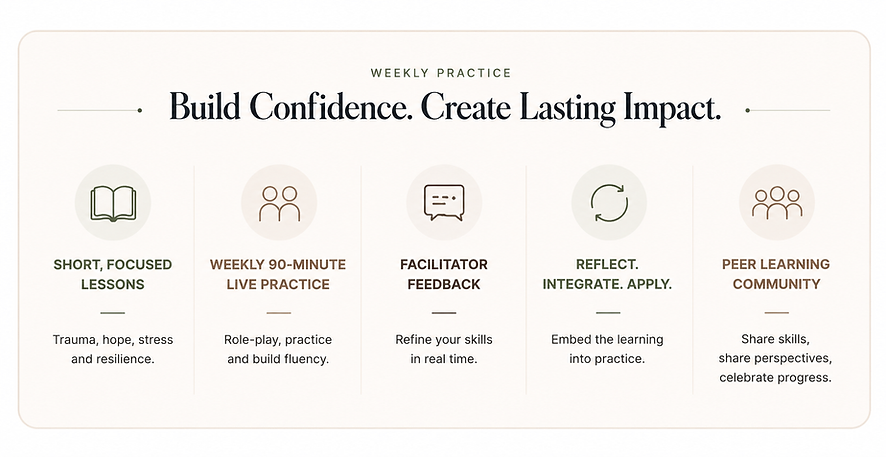
Join us every Friday morning (8:15–9:45am SGT) to unpack the modules, practice skills, and connect with your cohort.
There will be rest periods during holiday seasons like Christmas and Chinese New Year.
End May 2027
Certification & Gradation
You are fully equipped and we will continue to support your journey as you join the global weekly peer mentoring sessions.
BEYOND THE CREDENTIALS
Every journey starts with a reason
COMMON QUESTIONS
Frequently Asked Questions
Who is the Trauma Resilience Life Coach certification for?
The Trauma Resilience Life Coach certification is designed for counsellors, therapists, social workers, educators, HR and organisational leaders, and aspiring coaches. No strict clinical prerequisites are required to enrol.
What will I learn in the Trauma Resilience Life Coach certification?
You will develop a trauma-informed understanding of how trauma affects the brain, body and nervous system, alongside practical self-regulation, asset-oriented and resilience-building approaches. This can help you recognise trauma responses, work with people's existing strengths and support greater resilience and capacity.
What do I receive after completing the certification?
Graduates receive a Trauma Resilience Life Coach certificate from the Arizona Trauma Institute. Graduates can also access the ATI Coaching Lab, a monthly continuing education forum offering community calls, business collaboration and peer mentorship.
How is the certification delivered, and how much time will I need?
The programme runs for 6 months, requiring approximately 4 hours per week. It combines live interactive Zoom sessions, pre-recorded video modules and an active online discussion board. Cohorts are capped at 25 students, with 1:1 faculty mentoring for personalised instruction.
2 Sep 2026: Masterclass with Dr Rhoton
Registration Open